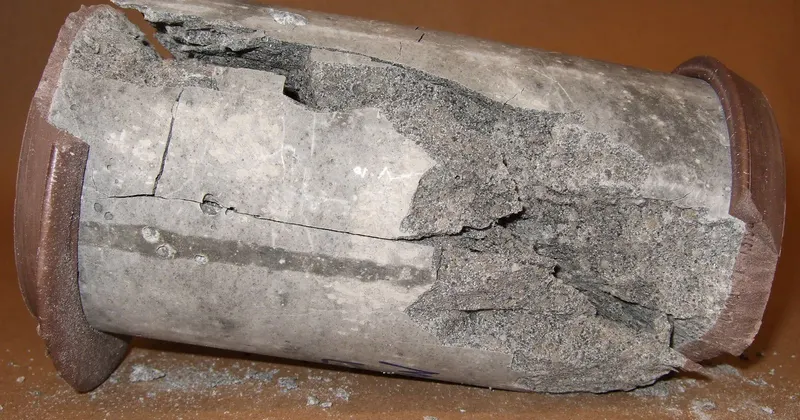
A low 28-day break result is among the worst news a concrete plant can receive: the concrete is already in place, the site is asking for explanations and you have to prove what was loaded into that truck. This article reviews how strength control works under the Código Estructural (Spain's Structural Code), which tests the plant carries out itself and which are done on site, how to interpret a break result and what is worth having to hand when a result does not add up.
Two different controls: the plant's and the site's
It helps to separate two things that are often mixed up:
- Production control is what the plant does on its own concrete. It is governed by Real Decreto 163/2019 (Royal Decree 163/2019), which approves the Technical Instruction for the production control of concrete made in central plants. Among other things, it requires each plant to obtain one strength result for every 300 m³ supplied of each specified strength or group of mix designs, with a minimum of one result per month.
- Acceptance control is what is done on site to check that the concrete delivered meets the project requirements. It is governed by article 57 of the Código Estructural (Real Decreto 470/2021), which replaced the EHE-08 (the previous Spanish structural concrete code) in November 2021. The site management is responsible for ensuring it is carried out, and the cylinders are usually made by a control laboratory.
The plant does not decide how control is carried out on site, but its production results are what allow it to defend itself if an acceptance break result comes back low. That is why it makes sense to keep both up to date.
One practical point: the instruction in Real Decreto 163/2019 was drafted when the EHE-08 was in force and still cites its articles. If you are unsure how those references apply today at your plant, check with the inspection body that audits you.
How samples are taken on site
The Código Estructural (section 57.2) sets out rules that everyone at the plant should know, because they determine whether a result is valid:
- The sample is taken in accordance with UNE-EN 12350-1, at the point of discharge, at the truck's outlet and between ¼ and ¾ of the way through the discharge. A sample from the very start or end of the load is not valid.
- The necessary cylinders are made from each sample: at least two are broken at 28 days and their average is the result for that batch. At least two more are kept in reserve in case testing at a later age is needed.
- The project supervision team, the contractor and the supplier may be present. The laboratory draws up a sampling record, and the person responsible for acceptance must give a copy to the supplier (section 51.4.2).
- The contractor or the supplier may request, at their own expense, a contrast sample.
If nobody at your plant keeps those records, start there. Without a record you do not know which delivery note was sampled, and without the delivery note you cannot tell which mix design it carried.
What happens to the cylinders until they are broken
Many low break results have nothing to do with the concrete, but with what happens to the cylinders in their first hours. Section 57.3.2 of the Código Estructural is quite specific:
- On site they must be protected from knocks, vibration, direct sun, wind and drying out: the surface covered with damp hessian or similar, and the moulds kept in a sealed bag.
- The surrounding temperature must stay at 20 °C ± 5 °C (25 °C ± 5 °C in hot weather). If this cannot be maintained for more than two hours, the contractor must provide an enclosure that ensures it.
- The cylinders remain on site for at least 16 hours and no more than 72 before going into the curing chamber. It is recommended not to exceed 48 hours, especially in summer. In winter, the minimum is 24 hours.
When a break result comes back low, ask for the conditions in which those cylinders were stored. It is one of the first things to rule out.
How to read a break result
Strength in the Código Estructural refers to cylindrical specimens of 15 × 30 cm tested in compression at 28 days (section 33.3). With that in mind:
- Each controlled batch gives one result, which is the average of its cylinders at 28 days.
- Cylinders from the same batch must be similar. The relative range (highest minus lowest, divided by the average) must not exceed 20% with three cylinders or 13% with two. If it does, the problem is usually in how the cylinders were made or tested.
- If 15 cm cube specimens are used, the result is converted to cylinder strength with a coefficient: 0.90 below 60 N/mm², 0.95 between 60 and 80, and 1.00 from 80 upwards.
- Conformity is not decided on a single cylinder, but by lots, using the acceptance criteria in section 57.5.4.3, which depend on whether the concrete has an officially recognised quality mark and on how many batches have been controlled.
How the works are divided into lots
In statistical control, which is the general approach, the works are divided into lots before supply begins. All the batches in a lot must come from the same supplier, with the same materials and the same nominal mix design. Some examples from table 57.5.4.1:
| Type of element | Maximum lot size | Batches to control without quality mark | With quality mark |
|---|---|---|---|
| Shallow foundations (elements under 200 m³) | 100 m³ or 1 week | N ≥ 3 | N = 1 |
| Beams, floor slabs, slabs and elements in bending | 100 m³, 2 weeks, 1,000 m² or 2 floors | N ≥ 3 | N = 1 |
| Columns and load-bearing walls in buildings | 100 m³, 2 weeks, 500 m² or 2 floors | N ≥ 3 | N = 1 |
With a quality mark, the lot size is multiplied by five (by two if the plant has certified dispersion), with a minimum of three lots per project. And no lot may cover more than six weeks of supply. The full table and its notes are in the Code; if a customer asks about a specific case, refer them to it and to their project supervision team.
What to do when a break result comes back low
What works is having the answer ready before the call comes in. A useful checklist:
- Identify the sampled delivery note using the sampling record: date, time, site, registration number.
- Pull the actual load for that delivery note: the cement, water, aggregates and admixtures weighed by the batching plant, and compare them with the formula.
- Look at the other loads that day with the same formula and, if there are any, their break results.
- Review your production control results for that strength in the surrounding weeks.
- Ask for the storage conditions of the cylinders and the range between them.
- Check whether water was added on site, which the Code expressly prohibits (section 51.4.2).
With that information, the conversation with the site stops being an argument and becomes a review of the facts. Any later decisions (complementary information tests, special studies) are taken by the project supervision team under section 57.7.
Break results alongside the delivery note in Gesthorm
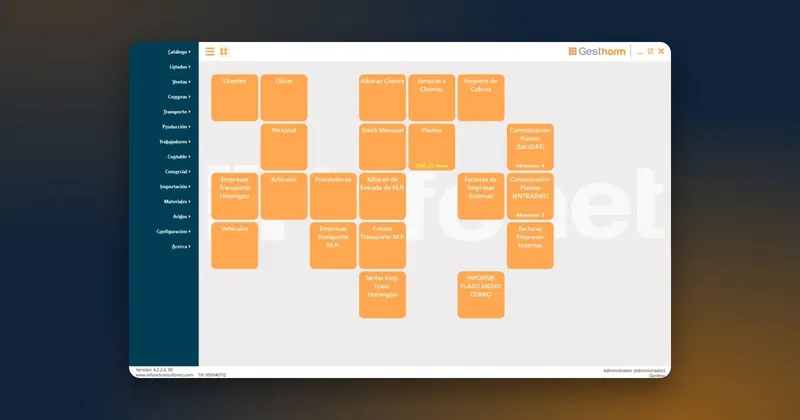
The step that takes the most time in that list is bringing together the delivery note, its load and its break result. Gesthorm collects from the batching plant every outgoing delivery note with the raw materials used to make it, thanks to the connection with the plant's loading software. On that same delivery note you can record quality controls by break result, and the application shows you the results next to the raw materials used.
As each formula is stored with its composition, comparing what was loaded with what was planned is immediate, and with custom reports you can pull all the loads of a formula over a period and export them to Excel. You can find the details of these functions in everything Gesthorm does.