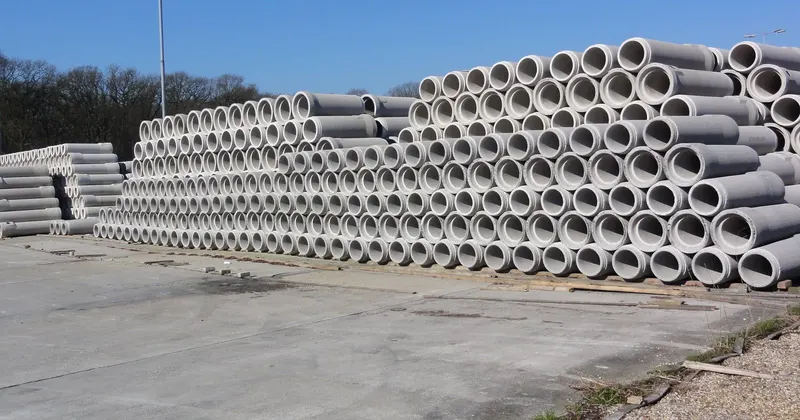
At a ready-mix concrete plant, what is made leaves through the gate at the same moment. At a precast plant it does not: units are cast, cured, wait in the yard and are loaded days or weeks later. That opens up two fronts that ready-mix does not have: finished-goods stock and traceability between each unit and the concrete it was made with. This article looks at how to organise both without losing control of costs.
What sets precast apart from ready-mix concrete
- The product is the unit, not the cubic metre. But cost still starts with the concrete, the steel and the accessories in each unit.
- There is a gap between making and selling: curing, demoulding, storage. Finished-goods stock ties up money and space.
- Moulds set your capacity: how many units you can turn out per day depends on the moulds and their cycle time.
- Traceability lasts longer: a unit cast today may be installed in a month, and if a problem appears you need to know which batch it came from.
Planning production
Useful planning starts from three lists:
- Pending orders, with unit reference, quantity and delivery date.
- Available stock of those references, minus what is already reserved for other orders.
- Mould capacity: which mould makes each reference and how often it becomes free.
With that, what needs to be made is the difference between what has been ordered and what is available, adjusted for the moulds. Producing for stock makes sense for fast-moving references; for made-to-measure units, it is better to produce to order so the yard does not fill up with pieces that may never sell.
Also bear in mind the curing and demoulding time of each reference. A unit is not available when it comes out of the mould, but when it reaches the strength needed to handle and transport it. If planning does not reflect this, impossible delivery dates get promised or units are loaded too early. The most practical approach is to set a minimum period between casting and loading for each reference, and not to count it as available stock until that period has passed.
Consumption per unit: the bill of materials
For each reference it helps to have a sheet with what goes into it:
| Component | Unit | What to check |
|---|---|---|
| Concrete | m³ per unit and mix | That the mix is the one in the design and the volume is the actual volume of the mould |
| Steel | kg per unit | Bar diameters and type of steel |
| Accessories | units | Anchors, inserts, spacers |
| Labour and mould | time per unit | Actual cycle versus planned |
The concrete in each unit has a cost that depends on its mix, and that mix changes in price with every purchase of cement, aggregates and admixtures. If the bill of materials is calculated once and never updated, the selling price drifts further and further from the real cost.
Compare theoretical and actual consumption from time to time. For example, if the bill of materials says a reference takes a certain volume of concrete and you have made a hundred units in a month, the concrete batched for that reference should be around a hundred times that volume. If it comes out considerably higher, there are moulds being overfilled, surplus being thrown away or broken units that have not been recorded.
Stock: raw materials and finished goods
In precast, two stocks coexist and need to be reconciled separately:
- Raw materials: cement, aggregates, admixtures, steel and accessories. They are reconciled by comparing deliveries received with consumption, just as at a ready-mix plant.
- Finished goods: units by reference, with their casting date and status. It is useful to distinguish at least "curing", "available", "reserved" and "defective".
For the physical inventory, walk the yard zone by zone and count by reference. Differences between the inventory and the theoretical figure may be due to units broken in handling, defective units not written off and loads that left without being recorded.
Quality and traceability
The Código Estructural (Real Decreto 470/2021, the Spanish Structural Code) devotes article 54 to precast elements and article 62 to their control. Two points directly affect how stock is organised:
- In concrete control, when concrete is made for precast elements, sampling is carried out at the pouring point of the precasting facility (section 57.2). If you record for each batch of units which mixes they came from, you can link each unit to its test results.
- The delivery sheet for precast elements has a minimum content set out in section 2.10 of Annex 4: identification of the supplier, number of the declaration of performance where CE marking applies, serial number of the sheet, name of the facility, purchaser, date and time of delivery, designation and quantity of the elements, quality mark if any, and place of supply.
On completion of the supply to a site, the contractor hands the project management a certificate for the precast elements, drawn up by the supplier (article 62). With stock properly managed, that certificate comes straight from the delivery notes; without it, it has to be reconstructed by hand.
Indicators worth reviewing
- Units made versus planned, by week.
- Defective or broken units, by reference and by cause.
- Age of finished-goods stock.
- Difference between theoretical and actual consumption of concrete and steel.
- Actual cost per unit versus selling price.
Gesthorm in a precast plant
Gesthorm is an ERP designed specifically for concrete production, quarries and precast, including its materials module. It handles raw-material suppliers, orders, delivery notes and purchase invoices, and the stock of each raw material at each plant, valued, with the mass balance between what comes in and what is consumed. Concrete mixes are stored with their composition and their cost per cubic metre, updated with every purchase.
Gesthorm is also open to being adapted to the particular needs of each company, which matters in a sector where every plant works in its own way. See mass balance and stock and everything Gesthorm does.