The quote for a job looked profitable until the transport costs and the admixtures nobody had planned for came in. The price per cubic metre of concrete that you give a customer is built from four items: the cost of the mix per cubic metre produced, transport, the extras for that job and the days it takes you to get paid. Every plant has its own raw materials and distances, so no single figure fits them all. Below you will find how to work out your own from your own costs, what the latest ANEFHOP data says (the Spanish association of ready-mixed concrete producers) and how to check afterwards whether the price was a good one.
What the ANEFHOP data says for the second half of 2026
According to ANEFHOP, in 2025 30 million cubic metres of ready-mixed concrete were produced, up 10.1% (press release of 07/04/2026). The trend continued this year: its press release of 06/10/2026 gives 8.32 million cubic metres in the second quarter of 2026, up 8.1%, and 31.3 million over the last 12 months.
The same release anticipates a slowdown in the second half of the year. With demand rising, keeping last year's rate and making up the difference with volume works fine. When activity slows, quotes get tighter and your margin depends on knowing the real cost of each cubic metre, job by job.
Price per cubic metre of concrete: what goes into it
Before setting a price, it helps to keep the items that make it up separate and to know where each one comes from in your plant.
| Item | What it includes | Where the data comes from |
|---|---|---|
| Raw materials | Cement, aggregates, water and admixtures in the mix | Cost of the mix per cubic metre produced and consumption from the batching program |
| Transport | Delivering the truck mixer to the job, with your own fleet or hauliers | Transport delivery notes by haulier, registration plate and driver |
| Extra additions | Whatever the job asks for outside the standard rate | Lines on the delivery note for that job |
| Returned concrete | What comes back to the plant and is not charged | Recorded returns |
| Payment term | The days between delivering and getting paid | The customer's average collection period |
On top of that come the overheads of the plant and the office, which each company allocates in its own way. If returned concrete weighs on your figures, you can see how to measure it in returned concrete: how to control and reduce it.
How to calculate the cost of each mix per cubic metre
This is the basis of the whole price, and the item that most often goes out of line when it is calculated once and left in a spreadsheet.
- Start from the composition of each mix: the quantity of each raw material per cubic metre.
- Value each raw material at the real purchase price for the period, including its transport to the plant.
- Compare the theoretical mix with the consumption recorded by the batching program on each delivery note: what is actually batched is what you pay for.
- Recalculate whenever the purchase price of cement, aggregates or an admixture changes.
Admixtures are the item that slips away most often in this calculation; it is covered in detail in concrete admixtures: how to control their consumption and cost.
Gesthorm stores each mix with its composition of raw materials and calculates its cost per cubic metre produced. Because it imports sales delivery notes, consumption and purchases from the plants' batching programs, each delivery note carries its consumption table with the cost of each raw material, transport and additions.
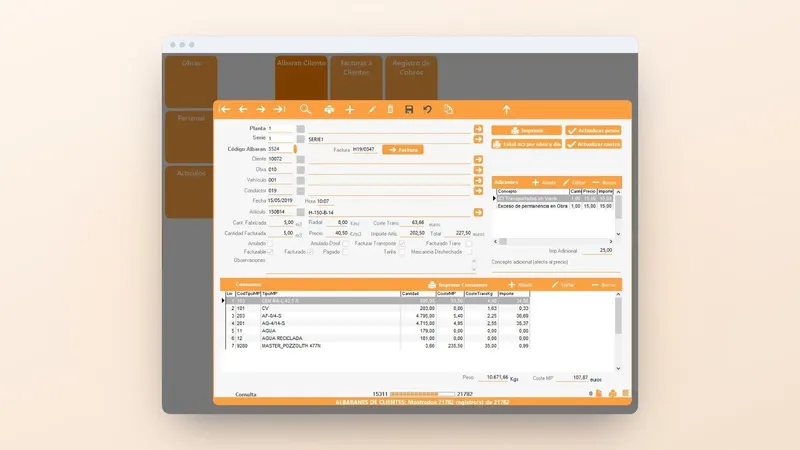
If the cost of your mixes currently lives in a separate spreadsheet and does not match what the plants consume, request a Gesthorm demo and we will show you how the cost per cubic metre is worked out from the delivery notes and consumption coming from the batching plant.
General rate or price per job
A single rate works as long as all jobs are a similar distance from the plant. As soon as a job is far away, calls for additions or is supplied in small loads, transport and extras eat into the margin of the rate. That is why it pays to set a price per job when the job has its own volume or conditions.
In Gesthorm, rates and prices per job coexist, with extra additions kept separate, and the delivery note is valued automatically at the price that applies to that job when it is invoiced. If you are preparing a large quote, the steps are in how to prepare a concrete quote for a large job.
How to tell whether the price you gave was a good one
The price in a quote is a forecast. The check comes with the delivery notes served: real cubic metres, real consumption and real haulage. In each quote, Gesthorm stores the theoretical profitability and, once the job is under way, shows the deviation from the quote and the real profitability.
The delivery notes by customer report brings together the cubic metres produced and manufactured, the cost of raw materials and transport, the total and the gross profit, with charts by product.
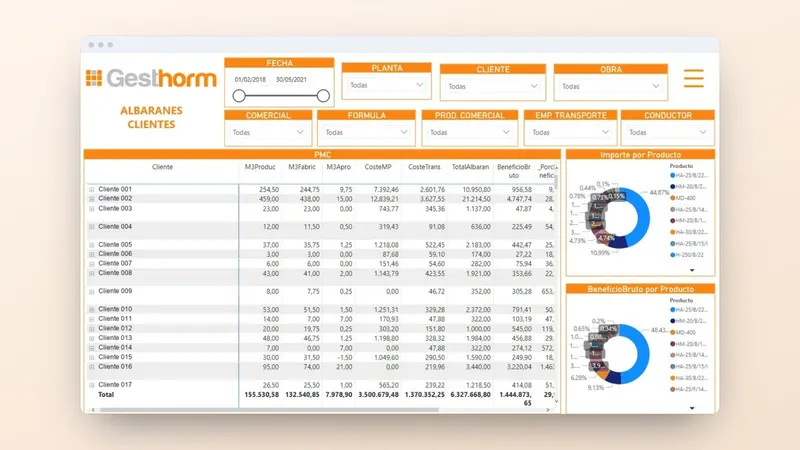
There is more detail on the page about the cost of a cubic metre of concrete in Gesthorm.
Collection days are part of the price too
Two customers who pay the same price per cubic metre do not leave you with the same result if one pays in 30 days and the other takes twice as long. Ley 3/2004 (Spain's late payment law), in its article 4, sets a payment term of 30 calendar days and, by agreement, never more than 60 calendar days. Put the payment terms in the quote and look at that customer's average collection period before settling the price.
Gesthorm calculates customer risk and the average collection period in real time from the delivery notes of all your plants; you can see it on the page about customer risk and collections.
What to do before your next quote
- Recalculate the cost per cubic metre of your best-selling mixes with this quarter's purchase prices and the plants' real consumption.
- Review the jobs in progress: compare the quoted price with what haulage and additions have really cost.
- Adjust rates and prices per job before the slowdown that ANEFHOP anticipates arrives, and set the payment term in writing within the 60-day limit.
If you want to see the real cost of each mix and the profitability of each job with your plants' data in one place, request a no-obligation demonstration of Gesthorm, call +34 959 54 07 12 or message us on WhatsApp at +34 621 39 39 47.